National Apprenticeship Week is celebrated every year in the UK to acknowledge the nation’s hardworking apprentices.
Apprenticeships are a widely recognised step in many people’s careers, and are available across many industries. They provide hands-on experience and valuable exposure to the workplace alongside dedicated studies and assessments in order to gain nationally recognised qualifications. These jobs are an excellent way to get started in the world of work.
In this blog, we are shining a spotlight on the valued team members who kickstarted their careers with Carver Engineering. Their apprenticeships granted them structured, on-the-job training, practical facility experience, and the chance to foster vital client relationships. That early education laid a solid foundation for their careers, equipping them with the crucial skills and expertise that remain central to the success of both their individual careers and our projects today.
Carver’s apprenticeship success stories
We’ve interviewed Carver employees across the business from a range of leadership levels, backgrounds, and qualifications:
- Andrew, Production Engineer. Has been with the company for almost eight years, and was studying for a Level 3 2D AutoCad and Level 3 NVQ Extended Diploma in Engineering.
- Jack, Production Manager, who’s been with Carver for almost 10 years. During his apprenticeship, Jack was studying to become a fully qualified fabricator welder.
- Jacob, Workshop Foreman. Jacob has now been with Carver for four years, and studied for a Metal Fabricator NVQ Level 3 during his apprenticeship.

How has your role evolved since you finished your apprenticeship?
Andrew: I have taken on more roles and responsibilities as a Production Engineer, such as overseeing the website and social media accounts, and learning how to operate our Trimble SX12 to conduct surveys and gather key information for projects. During an apprenticeship, you have a dedicated mentor to oversee your progression. Now, I’m responsible for myself – ensuring I’m efficiently completing tasks and meeting standards, while knowing there are experienced members of the team on hand for advice, if needed.
Jack: I started out as a very competent fabricator welder. As I progressed and gained more experience after my apprenticeship, I moved into the role of workshop foreman for two years. I worked for other engineering firms to expand my experiences and skills, later returning to Carver after three years in the Production Manager role.
Jacob: My role at Carver has progressed from an apprentice, to fully qualified plater, and now to a Workshop Foreman, where I supervise the staff in our facility and inspect all work and operations in progress.
What sparked your interest in engineering and steel fabrication for your career?
Andrew: I studied CAD at school, which introduced me to elements of engineering. From there, it made me think about what career I could go into that would allow me to progress and learn new skills in the engineering sector. When the apprenticeship at Carver came up, I knew it would be a great opportunity, and it was just what I was looking for.
Jack: I’ve always had an interest in engineering. When I was in school, my dad was a mechanic, so I enjoyed working on cars as a hobby. I simply enjoyed making things, so I was advised to try fabrication!
Jacob: I’ve always been inspired by impressive structures across the world, and knew I wanted to get into a career where I could engineer them and be part of the process.
How did the team at Carver support you when you were balancing your studies with your practical time at the facility or on-site?
Andrew: Their understanding that apprentices are actively learning new skills whilst on the job was reassuring. Having a team take the time to thoroughly explain a process that may be a simple daily task to them, but a whole new concept to me, was invaluable.
Jack: As an apprentice, I was given a lot of responsibility early on while having reasonable time to complete my coursework. Carver always trusted in my ability to complete tasks to a good standard, even when under pressure.
Jacob: Everyone at Carver always supported and encouraged my progression, from my direct mentors to other members of the team. I had one day a week on study leave to focus on college work, which was a massive help.

How did your apprenticeship prepare you for the responsibility of working on safety-critical engineering projects?
Andrew: The skills and knowledge I gained during my apprenticeship taught me all of the safety aspects needed for working in an engineering environment. Whilst you would always have an experienced team member overseeing you at work, I learned that you are ultimately responsible for yourself and your own personal safety.
Jacob: From learning on-the-job, my apprenticeship equipped me with all of the necessary and relevant skills and knowledge I needed to ensure safe working practices, which I now carry through in every project I’m part of.
As an experienced member of the team, how does it feel to be on the other side and mentoring the new apprentices?
Jack: It can be interesting, fun, and challenging all at the same time! We currently have five apprentices with different levels of ability and understanding. They are progressing well, and I focus on playing to their individual strengths, rather than weakness, to help them reach their full potential.
Jacob: Being able to pass on the knowledge that I gained during my apprenticeship to the next generation is a great and rewarding feeling.

Since you started your apprenticeship, how have you seen the technology and techniques within the fabrication sector evolve?
Andrew: Although it had been around for a while, I had never heard of a Total Station or knew what they were capable of when I first started. I would’ve assumed that if a measurement was needed, you’d use a tape measure! Now, from firsthand experience, I know the capabilities and accuracy that a device like Total Station can achieve and bring to a project. Scanners and Total Stations will be present throughout any major project.
With technology changing so much, what part of the job still requires that human touch and specialised eye for detail that can only be learnt by years of hands-on experience?
Jack: Working with steel can be a black art at times. Even with all the technology we have at our disposal, understanding how a structure might shrink or move under welding can be hard to anticipate. It takes a huge amount of on-the-job knowledge and experience to understand both how a part might move, and how to return it if it does.
Jacob: While fabrication has been greatly advanced by modern technology, its success largely still depends on the knowledge and particular skills which can only be learnt over many years. Thoughtfully done, on-site problem solving is a huge part of the job that technology can’t always help with.
Is there a particular project or structure you have worked on during your time with Carver that you feel particularly proud of?
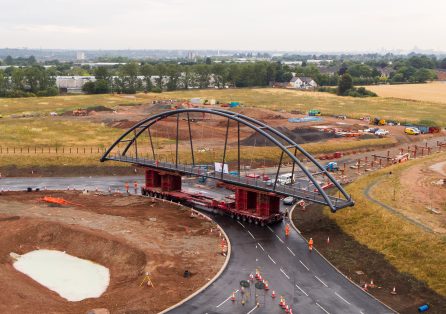
Andrew: Peddimore Footbridge. I used our SX12 Total Station throughout, which gave me more hands-on time in the workshop than I have had on other projects. I assisted with key steps of the project, from locating and marking slot positions, to setting the temporary works positions on-site to ensure smooth assembly. Having this involvement throughout the project felt especially rewarding after seeing everything come together seamlessly on-site.
Jack: Shortly after my apprenticeship, we were doing a large project for a railway station in central London. I had the chance to fabricate a huge tubular structure that one side of a bridge sat on top of, and even got the opportunity to go out on-site to fit it. When all the connections were bolted up with no issues, I remember being incredibly proud of what I had accomplished.

The long-term value of a steel fabrication apprenticeship
For businesses to invest in apprenticeships is an investment in their future workforce. By tailoring the development and training of our young apprentices, we’ve curated a team of fantastically skilled employees who have transformed the business. From young junior apprentices through to company leaders, the power of these work opportunities is invaluable.
A huge thank you and congratulations to the Carver employees who we have spotlighted in this blog. With your hard work and commitment to your personal development, you have taken our company from strength to strength whilst establishing your own remarkable career paths, becoming successful experts and leaders in your field.
Apprenticeships in steel fabrication engineering are an excellent way to gain valuable experience both on-site and in workshop facility spaces, while continuing your education journey to enhance your professional skills. If you are looking to start your career with Carver Engineering, get in touch with our team today.