When it comes to bridge fabrication, choosing the right materials is key. Steel and concrete are the two most common options, and each comes with its own strengths, costs and long-term considerations. Pick the wrong one, and it can mean higher maintenance costs or a shorter lifespan.
For more than 30 years, we’ve been trusted to deliver bridges for clients across the country. Having worked on everything from intricate railway infrastructure to highway bridges over the years, we have firsthand knowledge of how the right material can make or break a project.
We’ve created this go-to steel vs concrete bridge comparison guide so you can weigh up important criteria like performance, cost and longevity and make an informed choice for your next project.
Overview of steel and concrete bridges
What are steel bridges?
Steel bridges are where the load bearing components used in the construction, like beams, trusses and girders are made from structural steel. They’re renowned for being strong, flexible and able to span great distances without the need for large supports.

This makes them perfect for heavy-duty infrastructure, such as railroad bridges and highway overpasses where accuracy and durability are required due to harsh weather conditions and heavy traffic. Because of its high strength-to-weight ratio, steel can be installed more quickly and causes less environmental disturbance during construction.
What are concrete bridges?
Reinforced or pre-stressed concrete is used in concrete bridges to support weight and stress. They are frequently used for shorter distances, such as footbridges, local roads or overpasses in less demanding settings.
Concrete is particularly useful for projects with an architectural or decorative focus because it can be moulded into a variety of shapes. While it tends to be less expensive upfront, concrete is heavier and can be slower to install, especially in remote or difficult-to-access sites.
The pros and cons of steel vs concrete bridges
Cost-effectiveness
Concrete pros:
- Lower upfront costs for raw materials like sand, gravel and cement
- Often used in short-span, lower-load projects where material strength isn’t maximised
Steel pros:
- Lower site labour costs thanks to faster fabrication and installation
- Project delays less likely, particularly for remote or large-scale builds
Concrete cons:
- Long curing times may slow development
- Susceptible to weather-related delays during construction
Steel cons:
- Slightly higher initial material cost
Conclusion
Steel often proves more cost-effective over the full lifecycle, with savings in labor, time and future maintenance.
Longevity and durability
Concrete pros:
- Naturally resistant to corrosion in non-aggressive environments
Steel pros:
- High tensile strength handles heavy and dynamic loads
- Flexes under stress rather than cracking
Concrete cons:
- Can crack, spall and deteriorate in freeze-thaw cycles or harsh conditions
Steel cons:
- Needs protective coatings or galvanising to prevent corrosion
Conclusion
With proper maintenance, steel bridges last longer and provide more reliable performance under demanding conditions.
Sustainability and environmental impact
Concrete pros:
- Uses a variety of raw materials
- Can be recycled as aggregate
Steel pros:
- 100% recyclable – find out more about the sustainability of steel in our recent article
- Future reuse and waste reduction are made possible by modular design
Concrete cons:
- Cement production is one of the largest global sources of CO₂ emissions
Steel cons:
- It requires a lot of energy to produce, but this is compensated for by recycling and reuse
Conclusion
Steel is the more environmentally friendly option in the long run due to its complete recyclability and effectiveness in modular construction.
Speed and efficiency of construction
Steel pros:
- Off-site prefab cuts down on time and disturbance on-site
- Allows for quick installation even in difficult-to-reach places
Concrete cons:
- Lengthy formwork, curing and on-site setup
Conclusion
Steel takes the lead in speed and efficiency which is advantageous for projects where deadlines are crucial.
Maintenance and lifecycle costs
Concrete pros:
- Can require less maintenance early on if conditions are ideal
Steel pros:
- Easier to inspect, maintain and refurbish
- Well-suited for upgrades, retrofits and adaptive reuse
Concrete cons:
- Repairs are often complex and disruptive
- Retrofitting is difficult and expensive
Steel cons:
- Needs regular inspections and upkeep to manage corrosion
Conclusion
Steel is more flexible and economical to maintain over time, particularly for infrastructure that is anticipated to grow or change.
Aesthetics and flexibility in design
Steel pros:
- Allows for long, slender spans with minimal visual bulk
- Ideal for modern architectural expressions and complex engineering
Concrete pros:
- Provides choices for surface texture; appropriate for shorter, simpler spans
Conclusion
Steel delivers when it comes to striking designs, engineering freedom and visually impactful structures.
Project spotlight: steel bridges in action
Peddimore Footbridge – Minworth, Birmingham
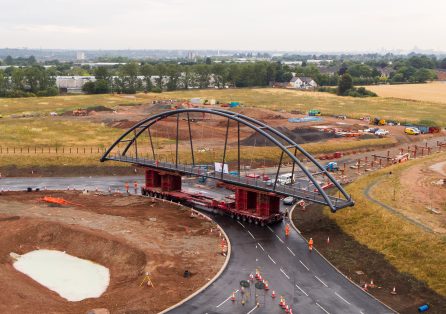
Overview: Constructed during the Birmingham Commonwealth Games under a rigorous three-week road closure embargo, this eye-catching steel tied-arch footbridge spans 60 meters over the A38 and has an arch that is 20 meters high and 6.5 meters wide.

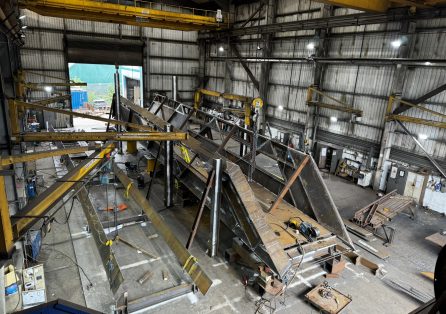
Our approach: To minimise disturbance, we fabricate at our state-of-the-art facility in Doncaster, trial-assemble off-site, then transport and assemble. Early-morning shifts were adjusted to accommodate the record-high temperatures. Using six SPMTs and tandem cranes, the installation was completed overnight.
Execution: To ensure structural performance and safety, the 90-ton structure was carefully lifted into position, bearings were installed, and the struts were tensioned.
Outcome: The bridge, which was finished ahead of schedule in July 2022, provides safe pedestrian access and demonstrates Carver’s aptitude for modular delivery, logistics planning, and execution under pressure.
Etruria Link Bridge – Stoke‑on‑Trent
Overview: This 800-ton steel plate girder bridge, which crosses the Trent & Mersey Canal and the West Coast Mainline, is a component of the SCAPE Framework. It acts as a vital connection between the Ceramic Valley Enterprise Zone and Festival Park.

Our approach: Carver completed design sign-off, fabrication, trial erections, and advanced off-site coating at our Doncaster facility using modular assembly techniques. This decreased the amount of time spent on-site and lowered interface risk for various trades.
Execution: During designated possession windows, 21 weathering steel braced pair girders (a total of approximately 200 meters) were pre-assembled, transported, and lifted into position. A smooth site integration was ensured by coordinating with other trades.
Outcome: The bridge, which was delivered in early 2022, now facilitates economic expansion and new connectivity. It demonstrates Carver’s ability to deliver, coordinate with stakeholders, and use precision engineering.
Final verdict: is steel the best material for bridge construction?
While both steel and concrete have their uses, the comparison speaks for itself. In crucial areas like construction speed, structural strength, long-term durability, and sustainability, steel performs better than concrete. Additionally, it is more cost-effective over a bridge’s whole lifecycle, particularly for contemporary infrastructure projects with strict deadlines, heavy loads and a need for future adaptability.
Steel fabrication is our speciality at Carver Engineering. We have provided intricate bridge solutions for the rail, highway, and marine industries thanks to our decades of experience in structural steel fabrication, detailed design, steel erection, and refurbishment. We manage every stage with in-house knowledge and a strict approach to quality and safety, from precision manufacturing to on-site steel erection.
Concrete may work for simpler, low-load applications. But for strength, speed and staying power, steel is the smarter investment.
Ready to get your steel bridge project underway?
Talk to the Carver team today. We’ll bring the experience, the tools and the talent to get it built right, first time.
Get in touch to discuss your upcoming infrastructure project or browse our recent steel bridge projects here.